
How an off-grid solar system runs
a home with no grid connection
How an off-grid solar system runs a home with no grid connection
Complete energy independence for rural blocks, sheds, farms and homes where a grid connection is expensive or unavailable. Your panels charge a battery bank, and the battery runs the house — day and night.
Complete energy independence for rural blocks, sheds, farms and homes where a grid connection is expensive or unavailable. Your panels charge a battery bank, and the battery runs the house — day and night.
Is off-grid the right system for you?
Off-grid isn’t simply solar without a meter — it’s a system sized to carry your entire load, every day of the year.
The grid is your backup
Draws from the grid at night or in poor weather
Excess solar is exported for feed-in credit
Shuts down during a blackout
Your battery is your backup
Stored energy carries the house overnight
No meter, no supply charge, no power bill
Unaffected by grid outages
The flow your energy makes
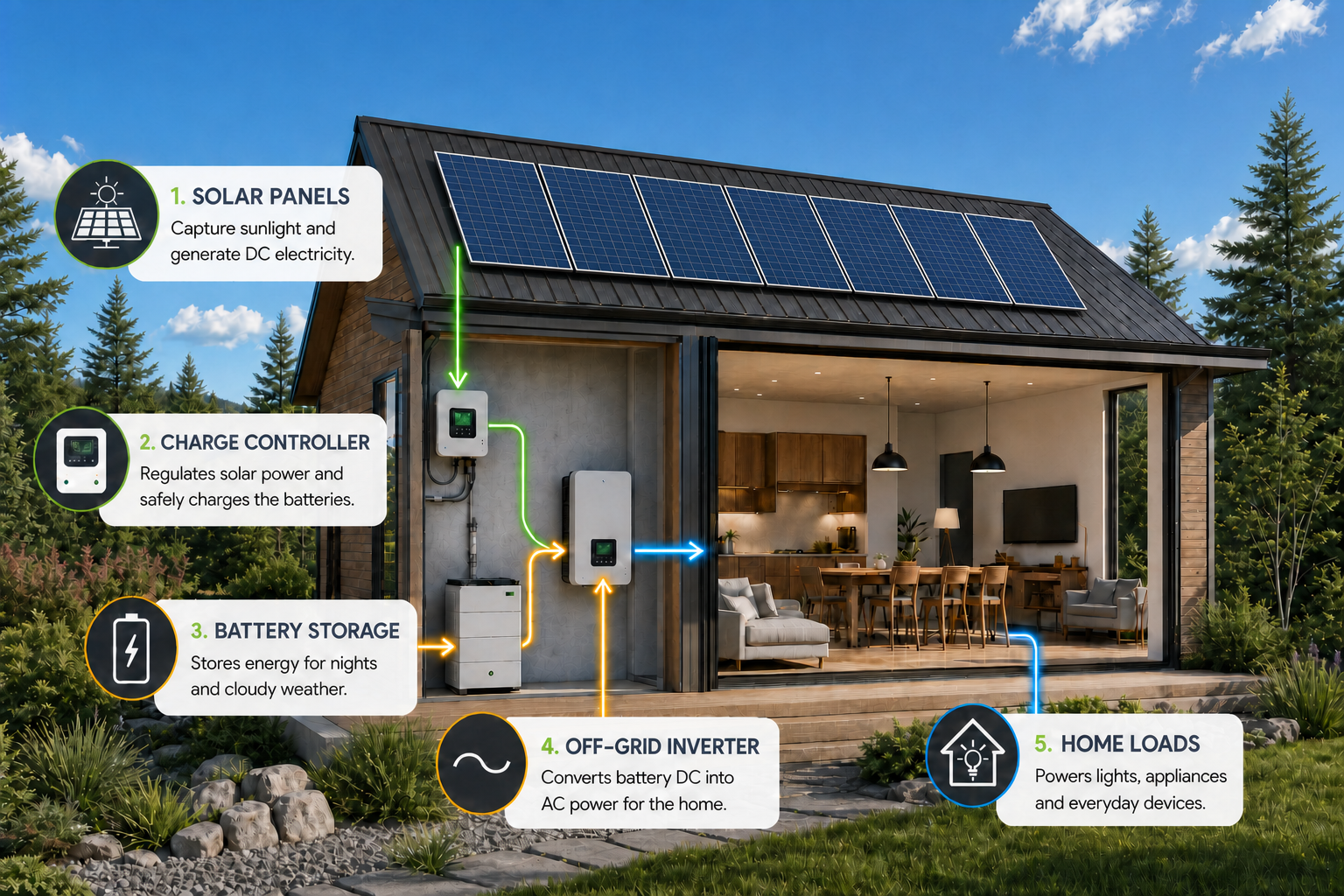
From sunlight on the roof to the light you switch on at midnight, here’s the full path electricity takes through an off-grid system.
01
Solar Panels
Panels on your roof or a ground-mounted array capture sunlight and generate DC electricity through the day. Off-grid arrays are sized larger than on-grid ones, so they still fill the battery in winter.
02
Solar Charge Controller
An MPPT charge controller regulates the DC power coming off the array and feeds it into the battery at the right voltage and current, protecting the cells from over-charging.
03
Battery Bank
The battery is the heart of an off-grid system. Every kilowatt-hour your home uses passes through it, so capacity is sized for several days of autonomy rather than a single evening.
04
Off-Grid Inverter
The inverter-charger converts stored DC energy into 240V AC and forms its own grid inside your home — holding voltage and frequency steady for every circuit in the house.
05
Home Loads
Lights, appliances, pumps and power points all run from the inverter, drawing on solar directly while the sun is up and on the battery once it sets.
06
Backup Generator
An optional auto-start generator tops up the battery during an extended run of bad weather or an unusually heavy load, so you are never left without power.
Sized for your worst week, not your best day
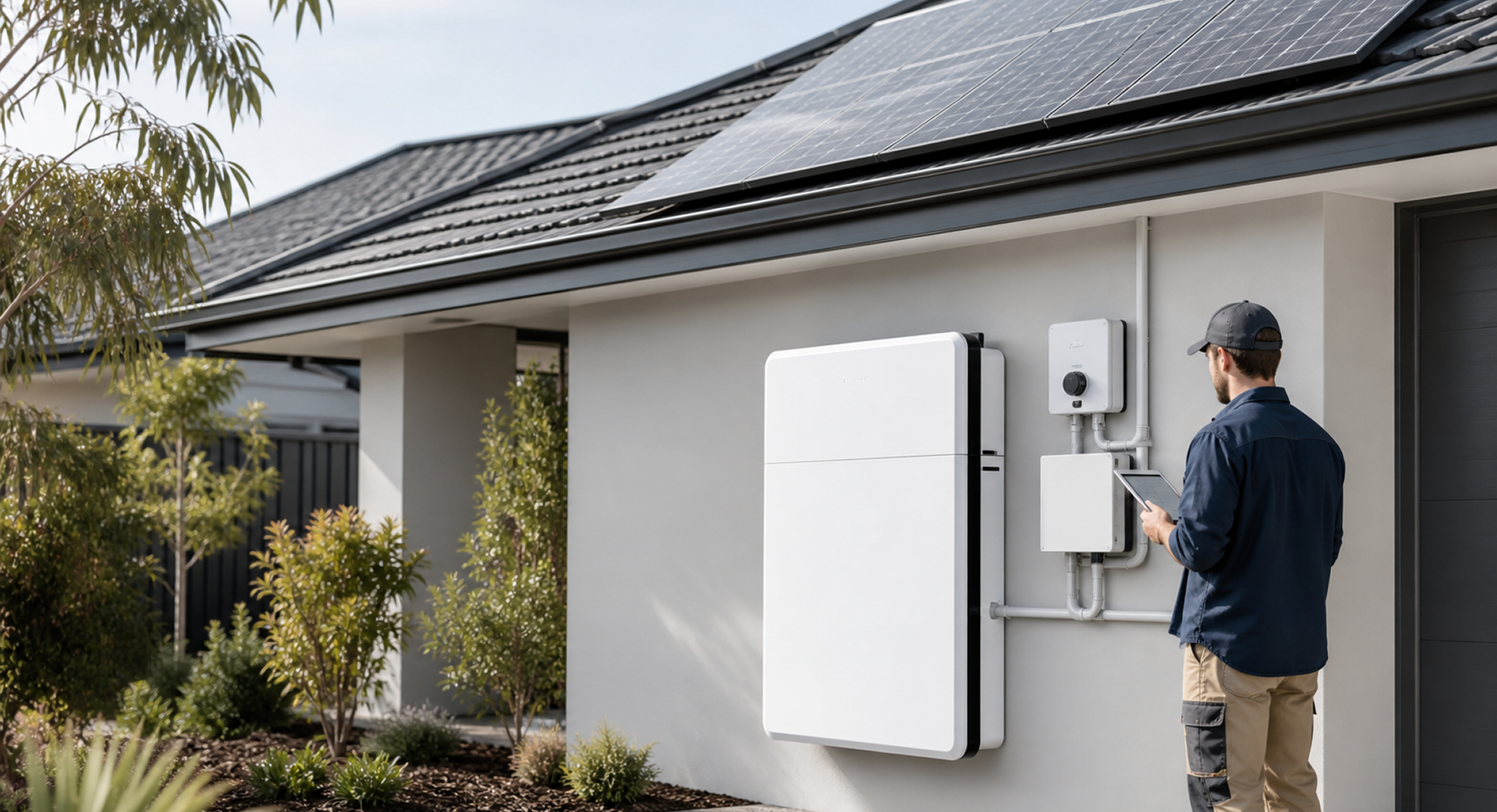
With no grid to fall back on, an off-grid design has to hold up through a run of overcast winter days. We start with your daily consumption in kWh, add the loads that matter most — pumps, cool rooms, air conditioning, welders — and then build in days of autonomy so the battery never gets pushed too deep.
- Daily usage audit — we map your kWh per day across summer and winter, appliance by appliance.
- Array oversizing— enough generation to recharge fully on a short, overcast winter day.
- Days of autonomy — usable storage to carry the property through consecutive low-sun days.
- Surge headroom — inverter capacity rated for pump and compressor start-up loads, not just steady draw.
What goes into your off-grid system
Every off-grid package is engineered as a matched set — panels, inverter-charger and battery bank designed to work together
Solar Panels
Tier-1 panels with a 25-year performance warranty, sized for off-grid arrays.
Off-Grid Inverters
Inverter-chargers that form their own grid and handle heavy surge loads.
System Design
A full load audit and engineered design before anything is quoted.
Get an off-grid design and quote
Tell us your location and what you need to run — we’ll model your daily usage, size the array and battery bank, and send pricing within one business day.
FAQ's
How much does an off-grid system cost?
Off-grid pricing depends almost entirely on your daily energy use. A small cabin system starts well under a full-home setup, while a house with air conditioning, pumps and a workshop needs a much larger array and battery bank. We quote only after a load audit, so the number you get reflects a system that will actually carry your property.
What happens after several cloudy days?
Our solar panels can still generate some power during cloudy weather, but production will be reduced. Luxmie off-grid systems are designed with larger solar arrays and battery storage sized for several days of low sunlight, helping keep your home powered through consecutive overcast days. If poor weather continues for an extended period, an optional automatic backup generator can recharge the batteries and provide additional power when needed.
Can I add to an off-grid system later?
Yes. Luxmie can design your system with future expansion in mind, allowing you to add more solar panels or battery storage as your energy needs grow.
Can I convert my existing solar to off-grid?
Yes, in many cases. Luxmie can assess your existing solar system and determine what can be reused, upgraded, or added to create a reliable off-grid setup.